
October 2026 | Education & Youth Advocacy
Imagine spending countless sleepless nights to be get accepted into your university, only to realize that affording your education might be a bigger challenge then getting in.
For thousands of Ontario students, this concern has become increasingly real. Recent changes to the Ontario Student Assistance Program (OSAP) are raising questions about student debt, accessibility and whether post-secondary education is becoming a financial privilege rather than an opportunity.

What’s Actually Changing?
On February 12, 2026, the Ontario government announced major changes to OSAP, which took effect for study periods beginning on or after August 1, 2026.
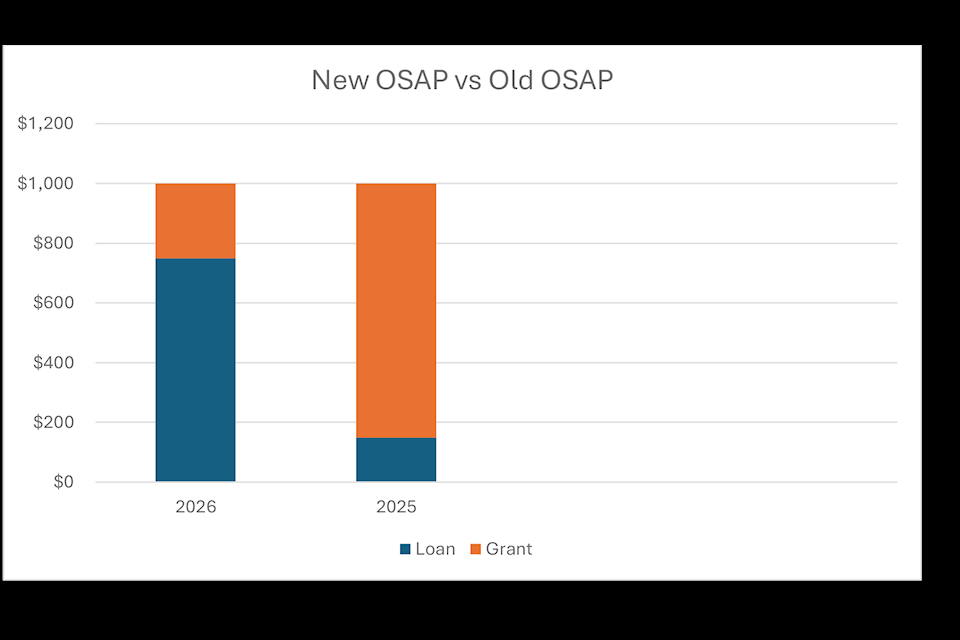
Previously, eligible students could receive up to 85% of their provincial OSAP funding as grants, which don’t need to be repaid.
Under the new system, provincial grants are capped at 25%, meaning at least 75% of provincial assistance will come through repayable loans.
The breakdown:
- Grants: Money students receive without having to repay it.
- Loans: Money students must eventually repay.
- New rules: Less provincial grant assistance and greater reliance on student loans.
These changes apply to the provincial portion of OSAP, not the federal portion. Students attending private career colleges will receive their provincial funding entirely as loans.
The government has also permitted publicly funded colleges and universities to increase domestic tuition by up to 2% annually for three years.
What Does This Mean for Students?
While students may still qualify for similar amounts of overall financial assistance, the difference is how much they’ll owe after graduation.
Example: You receiving $4,000 in provincial OSAP assistance. Under the new rules, no more than $1,000 could be provided as grants, leaving at least $3,000 as loans.
In this economy, this can become a huge burden for students.
Students from lower-income households may be particularly affected because grants have traditionally helped reduce their reliance on debt. Some students may feel pressured to work longer hours, reconsider their programs, or postpone their education altogether.
Why Is Ontario Making These Changes?
The Ontario government argues that restructuring OSAP will make the program financially sustainable while supporting a broader $6.4-billion investment in post-secondary education over four years.
However, student advocacy organizations have raised concerns that replacing grants with loans shifts more financial responsibility onto students, especially those who can least afford it.
Beyond the Numbers
Education should create opportunities, not become another barrier to overcome.
These changes raise an important question: If financial assistance increasingly means borrowing money, are we truly making education accessible?
Students shouldn’t have to choose between pursuing their future and protecting their financial stability.
At Beyond the Case, I believe understanding policies is the first step toward advocating for meaningful change. Because behind every funding decision is a student whose future may depend on it.
What do you think? Should Ontario prioritize grants over loans to make post-secondary education more accessible?
Sources & Further Reading
- Government of Ontario — Learn About OSAP
- Ontario Government — Postsecondary Funding Announcement, February 2026
- Ontario Undergraduate Student Alliance — Response to OSAP Changes
Disclaimer: This blog post is intended for informational and educational purposes only. The views expressed are my own and do not represent the Government of Ontario or OSAP. Information regarding OSAP policies, eligibility and funding is subject to change. Readers are encouraged to consult the official OSAP website for the most accurate and up-to-date information.


Leave a Reply